The Birth of a Nation (1915)

To fully understand the climactic Clansmen Rescue sequence in The Birth of a Nation (1915) it is necessary to first situate it in relation to the film’s overall racist ideological project. As a Civil War film, it overlooks the socioeconomic and political differences between the North and the South. Instead, the film proposes that the seeds of the conflict rested with the racial difference between whites and blacks and when the natural right of the former to rule over the latter was challenged by radical and misguided politicians. The Clansmen Rescue sequence supports this project by exploiting the moral valence of the rescue scenario. The sequence portrays the Ku Klux Klan as a heroic force that vanquishes Silas Lynch and his Black militia from control over the town of Piedmont.
The Black Pirate (1926)

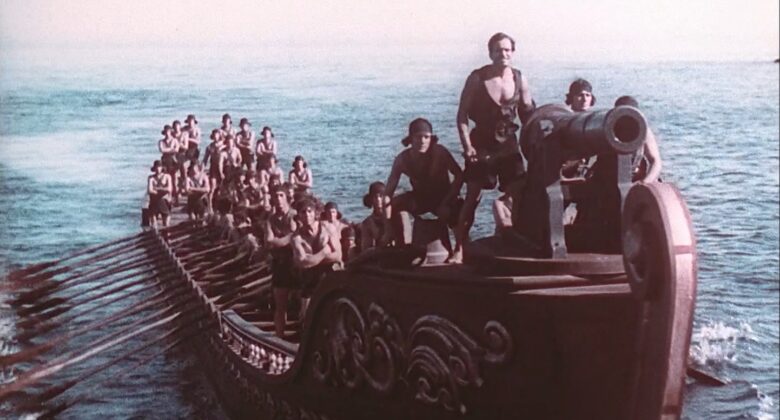
A feature of seafaring folklore, walking the plank was a mode of execution that extends as far back to popular writings on pirates in the 1700s. It is also a distinct variant of the fight scenario that is unique to the swashbuckler film. The walk the plank scenario appears in The Black Pirate (1926) and exhibits all the conventions associated with its event schemata.

The Charge of the Light Brigade (1936)

The final act set piece of The Charge of the Light Brigade (1936) is at once celebrated for the scale of the recreation of the Battle of Balaclava and notorious for the claimed number of horses injured or killed during its production. The sequence is unique beyond its reputation from an action scenario standpoint. The sequence is structured in terms of acceleration and a possesses a deadline structure that is interspersed with spectacular stunts.

Dirty Harry (1971)

The ransom rescue sequence in Dirty Harry (1971) clearly reveals how filmmakers can innovate the rescue scenario. On the hand, the sequence exhibits the prototypical character roles associated with the rescue scenario. The sequence features the captive — the kidnapped girl buried in the ground, the rescuer — Inspector Harry Callahan entrusted to deliver the ransom, and the captor — Scorpio the kidnapper who demands $200,000 in ransom for the release of the girl. On the other hand, the rescuing action presented in the sequence takes on a significantly different form. Instead of literally liberating the captive from their state of captivity, the rescuer in this instance provides a ransom to the captor in the belief that they will follow through on the release of the captive.

Dodge City (1939)

One of the most interesting features of action scenarios is their ability to adapt to the genres in which they are situated. This is specifically the case with the western and how it refashions the speed, fight and transfer scenarios. All such genre specific variations can be found in Dodge City (1939), including the saloon brawl, a staple of the western genre.