
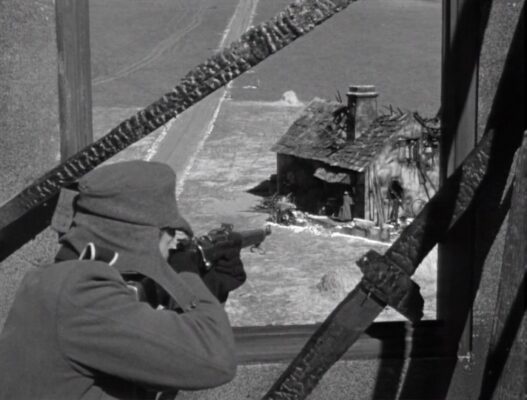
Source: Unknown Distributor: DVD, 2003.
Year: 1956
Director: Robert Aldrich
Action Stars:
Genre: Combat
Country: United States
Story Duration: 1:47:33
Act Duration:
1st Act: 00:28:57
2nd Act: 00:32:53
3rd Act: 00:18:58
4th Act: 00:26:42
Plot Turns:
1st: Fox Company ordered into action
2nd: Fox Company to pull out from farm house
3rd: Lt. Joe Costa attempts to rescue remaining Fox Company troops
ASD Ratio: 52%
AAD Ratios:
1st Act: 23%
2nd Act: 50%
3rd Act: 96%
4th Act: 65%
Action Structure: 1243
Action Scenarios:
Capture
Escape
Fall
Fight
Rescue
Speed
Total Action Moments: 24


Notable Action Sequence: German Advance
Duration: 00:14:12
Act: 3rd
Action Scenarios:
Fight
Speed
Description: Combat films are usually noted for showcasing battle sequences, normally situated in outdoor settings. However, Attack (1956) was based on Norman Brooks 1954 play Fragile Fox. Robert Aldrich decided to retain the theatrical dimension of the story by having the narrative focus of the German Advance sequence on the drama taking place inside the command post while the action scenarios instead primarily serve as exterior background context.
Aldrich employs four distinct strategies to maintain spectator awareness of the German advance while at the same time attending to Captain Erskine Cooney’s progressive loss of control over Fox Company. The first strategy is the use of off-screen sound to convey the context of battle. The viewer hears the constant sounds of shells being fired and exploding and is reminded of the vicinity of the battle in relation to the command post. In conjunction with this use of the sound, Aldrich deploys his second strategy through use of interior shots that show the command post rocked by exploding shells [Figure 1], a visualization of the explosions heard on the soundtrack.
The third strategy is to present brief cutaways from the interior of the command post to shots of the German advance [Figure 2]. These shots show the German forces on the move and headed toward the town in which the command post is situated. In so doing, the spectator is more actively cued to the advance of the German army to formulate expectations pertaining to their eventual arrival. The fourth strategy uses mise-en-scène, namely in the form of the door of the command post that is opened when characters enter and depart from the space. When opened, the doorway presents background views of soldiers rushing past conveying a context of urgency [Figure 3].
Collectively these strategies provide a context of action for the central drama of the scene. The viewer attends to Cooney’s indecisiveness and loss of respect amongst his men leading to a mental breakdown. Action does take place with the command post, but these moments are low-typicality instances of the fight scenario, such as when Cooney unidirectionally punches a German prisoner and when Lt. Col. Clyde Bartlett grabs, shoves and slaps Cooney as a result of his incorrigible incompetence [Figure 4]. In such ways the sequence presents a novel method to balance action with drama.
Hey There. I found your weblog using msn. That is a really neatly written article. I’ll make sure to bookmark it and come back to learn extra of your helpful information. Thank you for the post. I’ll certainly return.
Thanks for the feedback. Glad to hear.