

Source: Warner Bros: DVD, 2005.
Year: 1945
Director: Edward Dmytryk
Action Stars:
Genre: Combat
Country: United States
Story Duration: 01:32:56
Act Duration:
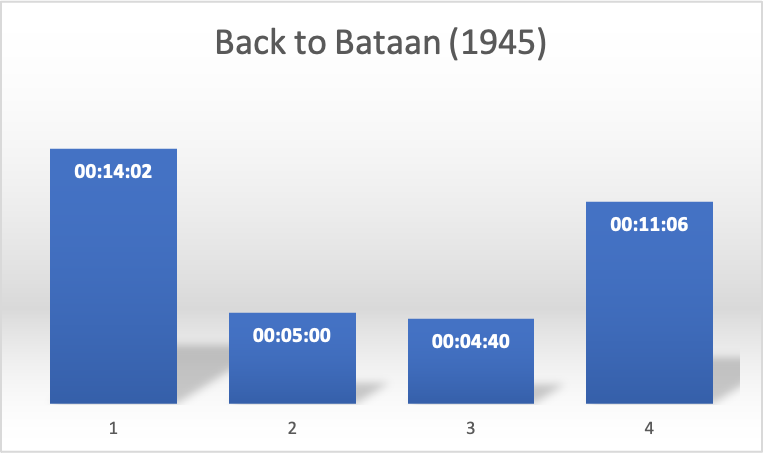
1st Act: 00:18:45
2nd Act: 00:22:38
3rd Act: 00:26:49
4th Act: 00:24:42
Plot Turns:
1st: Joseph Madden ordered to organize resistance
2nd: Japanese Captain hung in retaliation
3rd: Maximo captured
ASD Ratio: 37%
AAD Ratios:
1st Act: 75%
2nd Act: 22%
3rd Act: 17%
4th Act: 45%
Action Structure: 3241
Action Scenarios:
Capture
Escape
Fall
Fight
Heist
Rescue
Speed
Total Action Moments: 19
Notable Action Sequence: Japanese Assault
Duration: 00:06:00
Act: 1st
Action Scenarios:
Fight
Speed
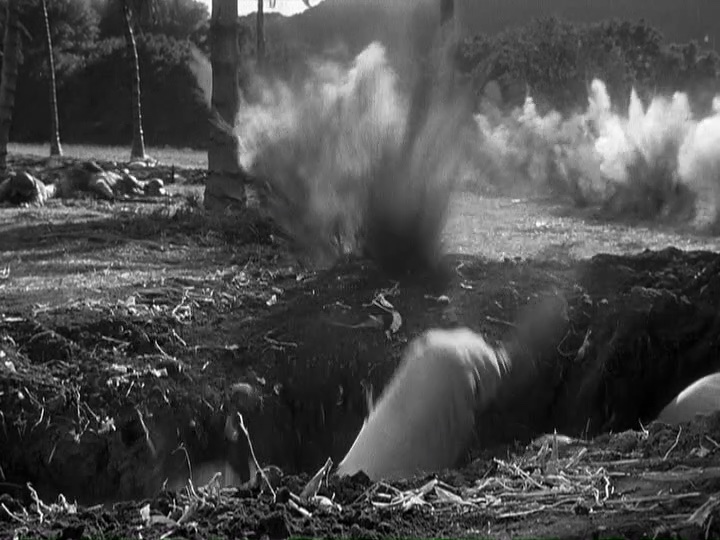
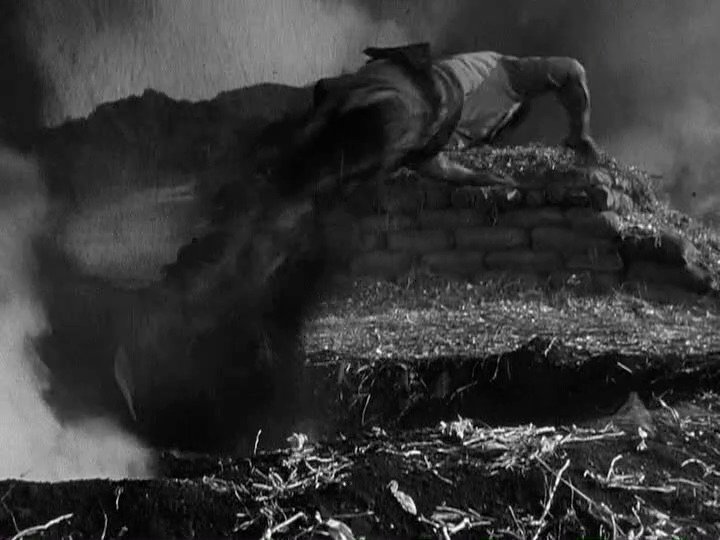
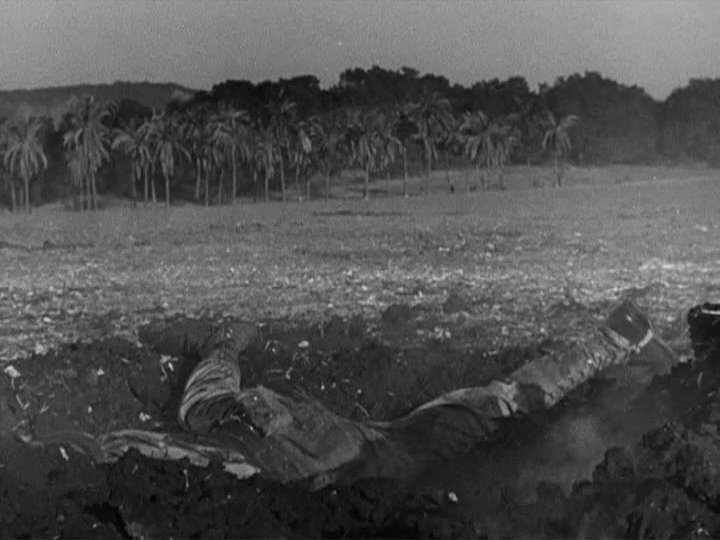
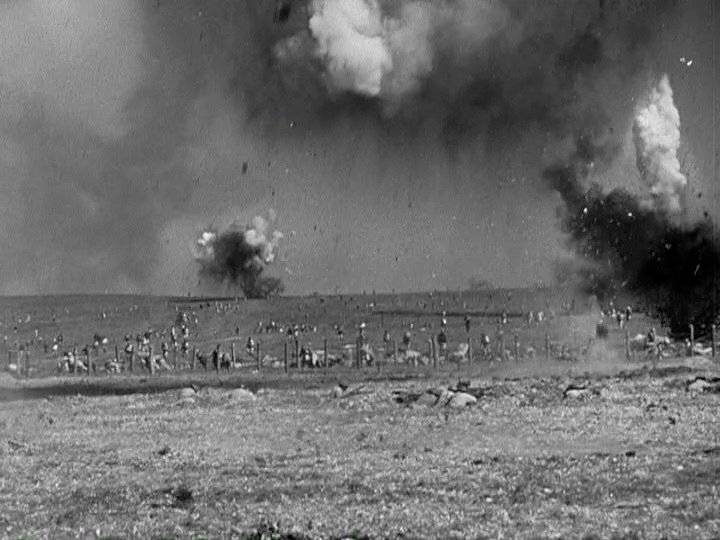
Description: Like other combat films of the period, Back to Bataan (1945) relies heavy on sound design to help shape the auditory and visual space of the battle field. In addition, depictions of violence in combat films also were constrained by the strictures of the Production Code. As a result, certain scenes of potential graphic violence in the film are rendered off screen, in shadow, or only the aftermath is presented.
The Japanese assault sequence commences when Colonel Joseph Madden orders Captain Andrés Bonifácio to focus on his command of his company of men. In the background the viewer can hear the sound of artillery as the battle commences. As Madden returns to the American position, a Japanese fighter aircraft can be heard overhead but is kept off screen as Madden dives into a trench to avoid being strafed by its gunfire [Figure 1]. Also heard on the soundtrack is the explosive force of artillery shells landing near the American trenches. One such explosion blasts Madden out of a crater sending him flying into the air and onto the ground [Figure 2]. While Madden is shaken as a result of the blast, one of his men is less luck as a shell directly hits him with his presumed death obscured by the soaring debris, and blasted body facing downwards, limiting the presentation of gore [Figure 3]. Artillery explosions continue on both sides of the battlefield [Figure 4], the power of which often conveyed by the audio of the blasts as well as the camera shaking from the force of the shock waves. The sequence transitions into the night as shells continue to explode. The Japanese forces play propaganda through a loud speaker as the soundtrack telegraphs the use of psychological warfare as well. Madden fires at the speaker with a machine gun in anger, an act that ends the sequence and terminates the sound of propaganda itself. *
*Later the spectator discovers that Dalisay Delgado, the voice of the propaganda heard over the speaker, is a Philippine citizen but acting covertly as a spy from the American forces.
I think other web site proprietors should take this site as an model, very clean and wonderful user friendly style and design, as well as the content. You are an expert in this topic!
Thanks so much!