

Share the post "The Lord of the Rings: The Fellowship of the Ring (2001)"
Source: Entertainment in Video: Blu-ray, 2010.
Year: 2001
Director: Peter Jackson
Action Stars:
Genre: Fantasy
Country: New Zealand
Story Duration: 2:50:11
Act Duration:
1st Act: 00:46:28
2nd Act: 00:46:32
3rd Act: 00:37:37
4th Act: 00:39:31
Plot Turns:
1st: Nazgûl discovers Frodo’s whereabouts
2nd: Formation of the fellowship
3rd: Gandalf’s presumed dead
ASD Ratio: 43%
AAD Ratios:
1st Act: 31%
2nd Act: 37%
3rd Act: 55%
4th Act: 53%
Action Structure: 1234
Action Scenarios:
Capture
Escape
Fall
Fight
Heist
Hunt (Fight Variant)
Pursuit
Rescue
Speed
Total Action Moments: 54

Notable Action Sequence: Gandalf Captured
Duration: 00:01:56
Act: 1st
Action Scenarios:
Capture
Fall
Fight
Description: As a fantasy film, The Lord of the Rings: The Fellowship of the Ring (2001) exhibits all the hallmarks of its genre, as one would expect from an adaptation of J. R. R. Tolkien’s 1954 classic high fantasy novel. The story takes place in Middle-earth, an imagined, self-contained world rather than our real one. Magic is also a central and pervasive force, whether it’s through magical artifacts like the One Ring or the abilities of wizards like Gandalf and Saruman. The film features mythical beings ranging from immortal Elves to grotesque and malevolent creatures like the Orcs, Goblins, and Trolls. As I noted in my book Action Scenarios in Film: The Essential Guide to Action in Film, the modality of a fight scenario changes with the film genre in which it’s situated. This holds true for fantasy films as well, with the fight between Gandalf and Saruman being an illustrative case.
Despite its brevity, running just under two minutes in duration, the scene amply reveals how the fight scenario can adapt to the generic traits of a genre and its characters. As wizards, it’s no surprise that the most notable aspect of the fight scene is the use of Gandalf’s and Saruman’s magical powers, often through the deployment of their staffs. What makes such use particularly distinctive is that it involves no physical contact between them, constituting a significant variation of the fight scenario prototype.
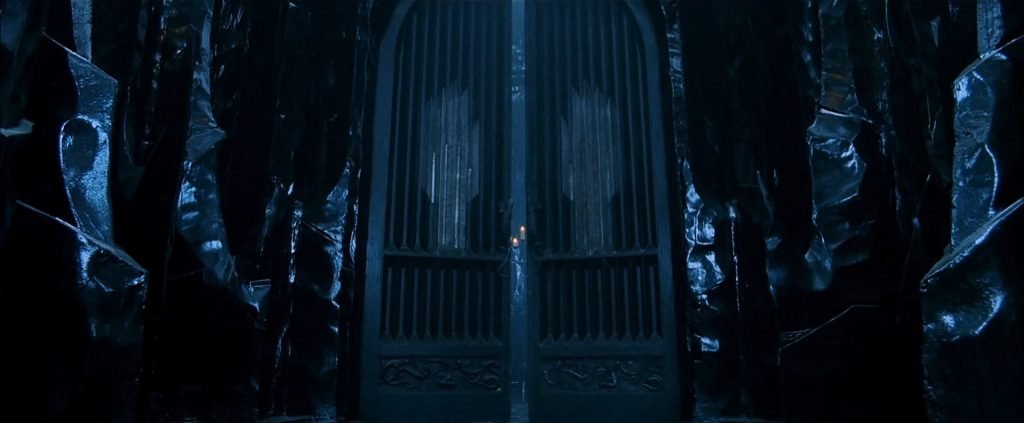
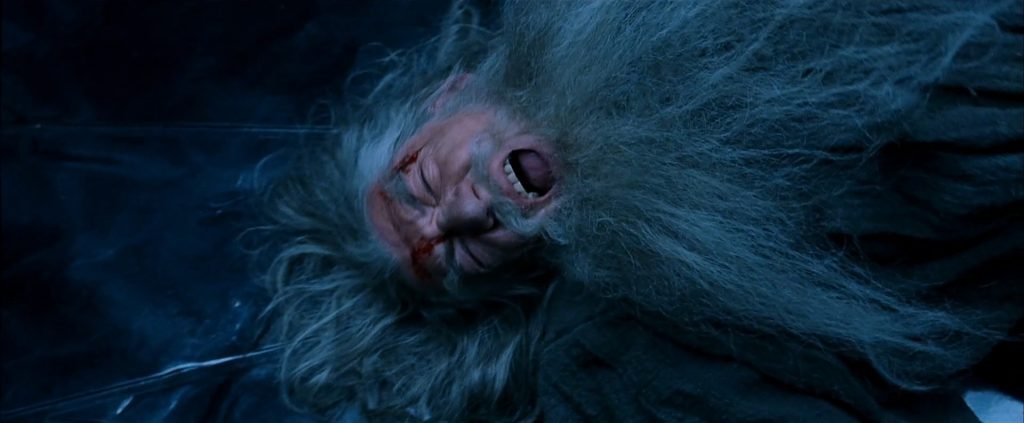
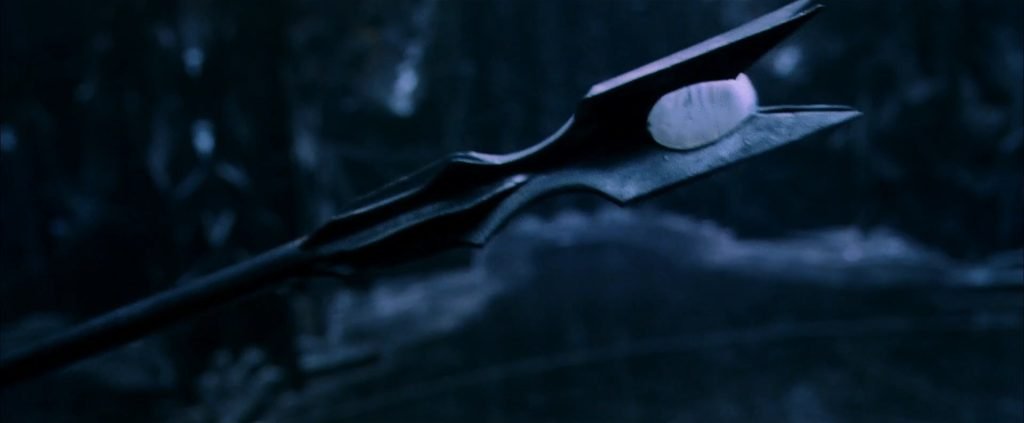
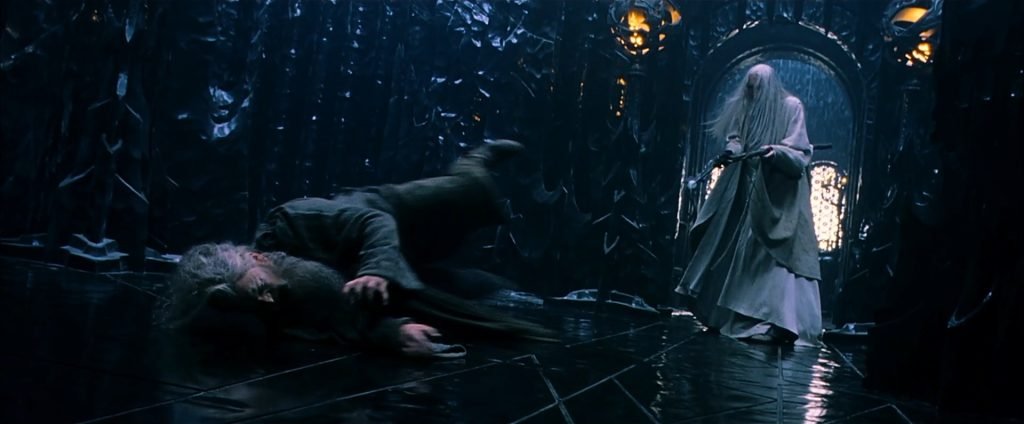
The action commences first as a capture scenario. To prevent Gandalf from leaving the tower and coming to Frodo’s aid, Saruman uses his magical powers to close all the doors of the room while remaining seated on his throne, thereby preventing Gandalf’s departure [Figure 1]. Gandalf then rejects Saruman’s offer to join forces with the Dark Lord Sauron. Before Gandalf can deploy his staff as a weapon, Saruman uses his, sending Gandalf soaring upward into a wall. Gandalf eventually releases himself from Saruman’s magical grip, falls to the floor, and thrusts his staff towards Saruman, causing him to flip over. Saruman counters by swinging his staff towards Gandalf, propelling him to fall onto the floor with such force that blood appears on his forehead despite no direct physical impact [Figure 2]. Gandalf returns the blow with his staff, as if making contact with Saruman’s head, which knocks him to the ground. Assuming the upper hand, Gandalf swings his staff in the direction of the opposing wall, sending Saruman to crash against it. But Saruman quickly regains control and thrusts his staff forward as a magical weapon [Figure 3], spinning Gandalf in the air before he crashes to the floor. Saruman then throws Gandalf around like a rag doll. In a final act of defense, Gandalf whips his staff, forcing Saruman hurtling through a door. Saruman nonetheless rises again and reaches out for Gandalf’s staff, sending it speeding into his own hand—a potent indication of the extent of his magical powers. Wielding two powerful magical staffs, Saruman knocks Gandalf to the floor once more and makes him spin [Figure 4], assuming total control of his opponent. Powerless, Gandalf is then hurtled upward to the top of the tower by Saruman, with his fate to be revealed later in the film.