
The opening chase sequence in Mad Max (1979) augurs, on a smaller scale, the multi-vehicle pursuit that would become a trademark for the Mad Max franchise.

The opening chase sequence in Mad Max (1979) augurs, on a smaller scale, the multi-vehicle pursuit that would become a trademark for the Mad Max franchise.

Antoine Fuqua’s remake of The Magnificent Seven (1960), itself a remake of Akira Kurosawa’s Seven Samurai (1954) that inserts its plot within the narrative context of the western, follows its predecessors by allocating the bulk of its action to the fourth act, as attested by its atypically high AAD ratio

One of the ways that action films make themselves distinctive is by defamiliarizing the genres on which they are based through unique genre combinations. Nobody (2021) does so by combining elements from the espionage film with that of the gangster movie, a sub-genre of the crime film. This combination assumes its primary shape through the film’s protagonist-antagonist structure.

The final act action sequence in Once Upon a Time in China (1991) runs close to 30 minutes in length, and takes up 93% of the fourth act of the film.

Nothing in action films signals the agency of the hero protagonist as much as the ability to switch from a captive to an escapee. In Rambo: First Blood Part II (1985), Rambo accomplishes this feat during the interrogation scene, replicating the same captive-escapee reversal executed in the film’s predecessor First Blood (1982). From this point on, Rambo’s agency in the film increases exponentially from a devastating avenger to a deliverer of salvation by rescuing American prisoners of war from a brutal Vietnamese prison camp.

The bank robbery pursuit in Point Break (1991) is one of the key set pieces of the film, primarily for featuring one of the best foot chases in action cinema history.

Despite its modest length, the opening invasion sequence is notable for its economy in setting up the primary narrative premises that go on to shape the film’s overarching story.

As one would expect from a prison film, the main set piece of San Quentin (1937) is an escape sequence that involves a well-staged vehicular pursuit.
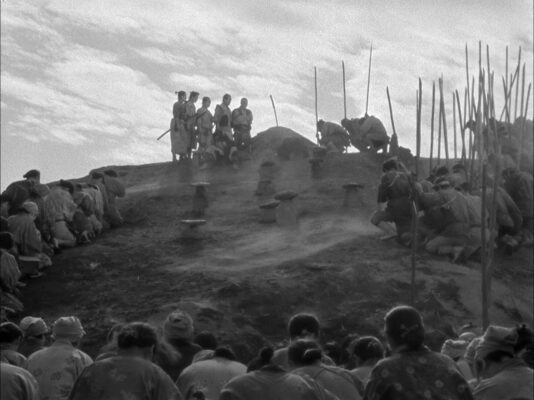
Amongst the most influential action films ever made, Seven Samurai (1954) is also significant for its sheer epicness concerning its story as well as its duration. With a story duration of over 3 hours and 18 minutes, the Seven Samurai manifests a staggering 54 distinct action moments that generally grow in length as the film reaches its climax.

There are a number of qualities that make Sholay (1975) a distinct film. As a masala western, the film is a hybridization of the plot structure of the Hollywood professional western, with the Hindi cinema of interruptions in which song and dance numbers are inserted into the film’s plot, and elements of the Indian dacoit (bandit) genre. But what really distinguishes Sholay from other action films is the way in which the film’s song and dance numbers are integrated into action scenarios.