
While the first sequence in which Rambo is hunted down by the pursuing police posse in First Blood (1982) showcased his survival skills, the second capture sequence focuses upon highlighting Rambo stealth fighting abilities.

While the first sequence in which Rambo is hunted down by the pursuing police posse in First Blood (1982) showcased his survival skills, the second capture sequence focuses upon highlighting Rambo stealth fighting abilities.

Takashi Yamazaki’s Godzilla Minus One (2023) is at once a reboot of the original 1954 Godzilla film and a homage to the first installment of the franchise. This relationship between the two films is most strikingly manifested during the Attack on Ginza sequence – a composite of the first two Godzilla attacks on Tokyo in the original – where a number of parallel moments arise. Yet, Godzilla Minus One reconfigures this attack in a pivotal way by placing its central characters, Kōichi and Noriko, directly within the devastation, thereby dramatically raising the stakes. This contrasts with the principal characters in the first film, who witness Godzilla’s rampage but from a far safer distance.
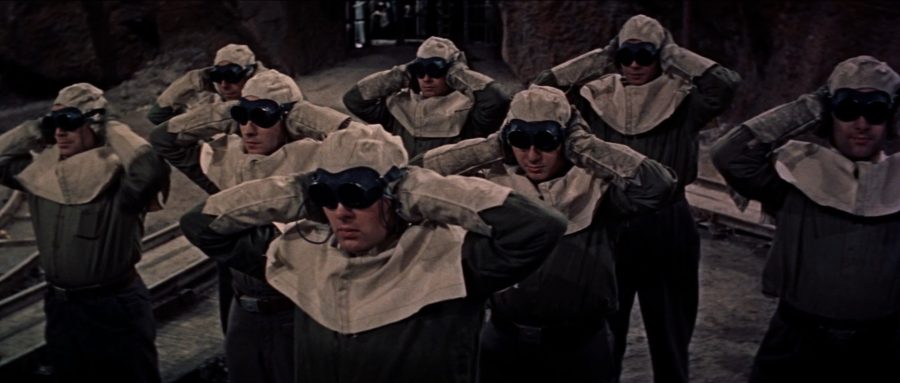
The arrival of the mission team to Navarone Island is marked by two notable sequences that underscore how nature itself can supply precarious environments to situate action.

One action scenario that is particularly showcased in Iron Man (2008) is the speed scenario. Tony Stark’s Iron Man armor is the principal reason for this emphasis that is not only weaponized in a variety of ways but is also fitted with arc-reactor-powered repulsors that allow Stark to travel at supersonic speeds.

Hardcore Henry (2015) is a unique cinematic experiment as an amalgam of the science fiction film, combined with the aesthetics of the First-Person Shooter (FPS) video game. Shot entirely from the optical point of view of Henry, the cyborg protagonist, the film aligns the viewer with Henry’s perspective as he pursues goals that are more akin to gaming level progression than character development. With an unprecedented 87% action-to-story ratio, the film also claims the title of the most action-packed film analyzed on this website.

It is not unusual for crime films to exhibit a fatalistic dimension but High Sierra (1941) exhibits this film noir trait in a unique way.

The El Mirage Lake shootout featured in Lethal Weapon (1987) closes in a manner typical of 3rd acts in mainstream films, namely through an all-is-lost moment. The moment is dramatically heightened given that it constitutes a reversal of Roger Murtaugh and Martin Riggs’ original rescue plan to save Murtaugh’s daughter Rianne from the hands of Shadow Company, an ex-special forces unit involved in drug smuggling.

One of the most memorable moments in the film occurs when Charles Xavier suffers a seizure at a casino in Oklahoma City.

The Operation Honeymoon sequence in The Long Kiss Goodnight (1996) is similar to other final act action sequences during this period in terms of length, multiple plotlines, and multi-character construction.

As a fantasy film, The Lord of the Rings: The Fellowship of the Ring (2001) exhibits all the hallmarks of its genre, as one would expect from an adaptation of J. R. R. Tolkien’s 1954 classic high fantasy novel. The story takes place in Middle-earth, an imagined, self-contained world rather than our real one. Magic is also a central and pervasive force, whether it’s through magical artifacts like the One Ring or the abilities of wizards like Gandalf and Saruman. The film features mythical beings ranging from immortal Elves to grotesque and malevolent creatures like Orcs, Goblins, and Trolls. As I note in my book Action Scenarios in Film: The Essential Guide to Action in Film, the modality of a fight scenario changes with the film genre in which it’s situated. This holds true for fantasy films as well, with the fight between Gandalf and Saruman being an illustrative case.