

The Problem of Interruptions
In previous posts, I have discussed how to identify action in film and how to measure it. In this post, I want to turn to the issue of what constitutes continuous action. Consider the recurrent scene in which the protagonist and the antagonist of a film are locked in some type of combat and pause to banter, and after exchanging insults, resume their fight. Do we treat the scene as a whole as continuous action and the pause in action a mere blip? Or should we consider the banter as a more significant interruption that separates the action into two separate moments? The question poses the problem of interruptions in action. Since interruptions can assume many forms, this post will consider the cases in which interruptions do not entail discontinuous action and the cases in which they separate action into distinct moments.
To do so, I set out 15 principles by which continuous action can be established and delimited. The first section of this post explains these principles, citing a range of examples from films that represent the potential for different forms of interruptions to the continuity of action. The second section of the post provides a decision chart based on these principles by which one can decide whether continuous action is manifested or not at the level of shot change.
1. Action Scenario Continuity: Shot Change
At the most fundamental level, films normally present a series of changing shots. Those changes are often manifested by a cut to a different shot.¹ Shot changes, therefore, can be considered potential interruptions to that flow. When a shot depicts an instance of an action scenario, and the next shot depicts a continuation of that instance of action, then it is evident that the change in shot does not constitute an interruption since action continuity presides over the shot change. For example, the crash scene when Goose flies off the road in Mad Max (1979) manifests a speed action scenario. A shot presents the moment when Goose sails off the road and into a field [Figure 1], which is then followed by a shot depicting Goose and the motorcycle airborne [Figure 2]. Despite the change in camera setup and shot, the instance of the speed scenario continues.


2. Action Scenario Continuity: Dialogue
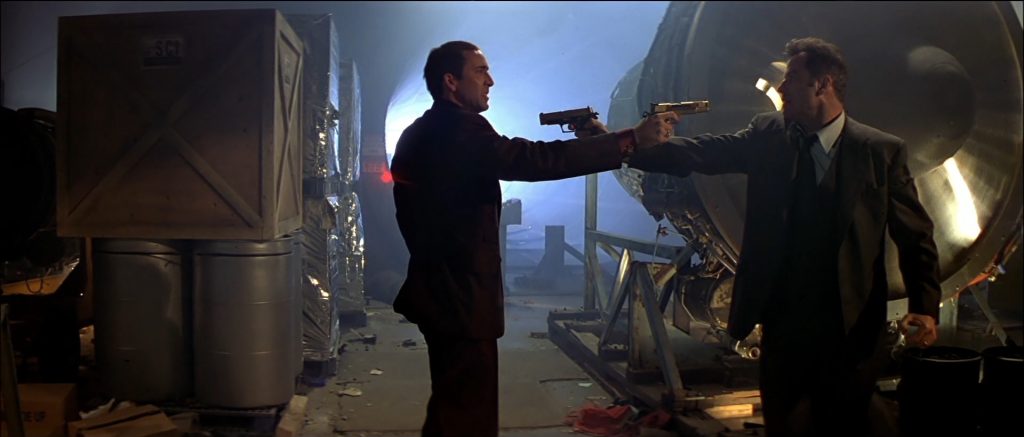
Let’s return to the narrative situation posed in the introduction, where an action scenario, normally an instance of the fight scenario, is paused as a result of characters exchanging dialogue with each other. Do such conversational moments consequently interrupt action continuity? The answer hinges on whether there is ongoing action or not during the dialogue exchange, an issue that is raised throughout the delineation of these principles. An illustrative instance of such a situation can be found in the airport sequence in Face/Off (1997), in which FBI agent Sean Archer and his team attempt to capture master terrorist Castor Troy and his crew. During a prolonged gun battle, Archer and Troy end up in a standoff with their guns pointed at each other [Figure 3]. Troy then cruelly taunts Archer about his daughter and informs him that he has put in place a future terrorist act. Troy fires his pistol at Archer, but discovers its chamber is empty and falls to his knees in an insidious move to pretend to be pleading for mercy as he whips out a knife. Archer, however, kicks the knife away and, with another forceful kick, sends Troy flying into the path of an activated jet turbine engine nearby [Figure 4], actions that return the sequence back to fight and capture scenario modes. During the dialogue exchange, it is clear that neither Troy had abandoned his efforts to elude capture nor that Archer no longer sought to apprehend Troy. Those intentions remained present, with the fight and capture scenarios ongoing through the dialogue exchange, except in latent form.

3. Action Scenario Continuity: Plot Turns
A plot turn is an incident in a film’s narrative in which the story is taken in a different direction, often impacting on the goals of the protagonist. Do plot turns then constitute moments in film that interrupt the continuity of action? To answer this question, it is important to recognize that there are two types of plot turns. The first type of plot turn consists of those that apply at the micro-narrative level, as was discussed in relation to X-Men (2000) and the features of action complexity exhibited in its 4th act extended action sequence. One of the features of action complexity is the insertion of plot turns to introduce change to sustain audience interest. Given that action moments routinely involve combinations that entail inherent moments of change, as discussed in Principles 12 and 13, the introduction of change in and of itself does not constitute an interruption to action continuity at the micro level. The second type of plot turn operates at the macro-level and separates the larger narrative segments of a film, which screenwriters refer to as acts. Since macro-level plot turns divide acts in film, it seems reasonable to explore whether they function in the same way in relation to action sequences.
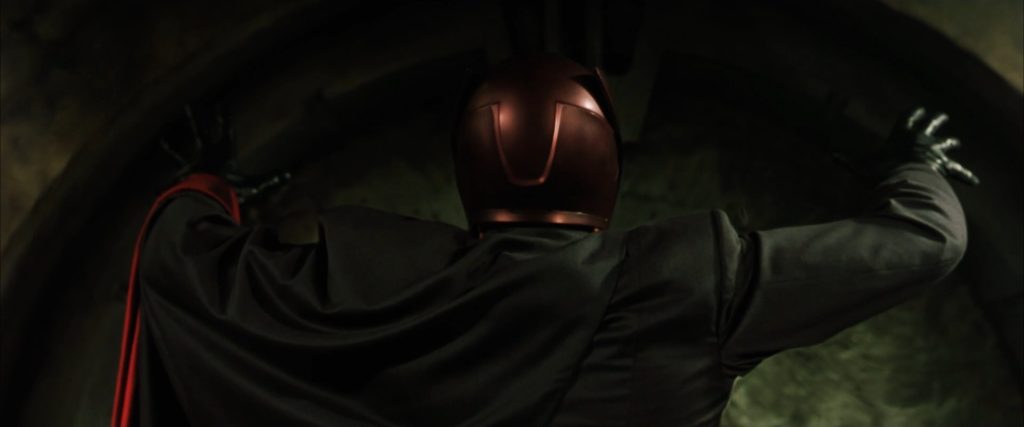
An examination of the plot turn that separates the 3rd and 4th act in X2 (2003) indicates that macro-level plot turns do not necessarily interrupt action continuity. Colonel William Stryker, the antagonist of the film, has built a second Cerebro on his base at Alkali Lake. The original was a sophisticated computer system used by Professor Charles Xavier to detect and track mutants around the world. Stryker rebuilds the machine so that his telepathic son, Jason, can mind-control Xavier to use the machine to locate and kill every mutant on the planet. Magneto, working with the X-Men team, travels to Stryker’s base to halt his deployment of a second Cerebro. The collective rescue team separates at the base, with their encounters depicted in several plotlines. Magneto eventually makes his way to the chamber containing the Cerebro and directs his magnetokinesis abilities at it to temporarily shut down the machine down [Figure 5]. The act terminates the psychic energy directed at the mutants and rescues them from certain death, thereby enacting a major plot turn that brings the 3rd act to an end. The 4th act commences shortly after, when Magneto enters the chamber with his plan to redirect Cerebro’s immense psychic energy to target all humans, a similar weaponization of the machine when under Stryker’s control [Figure 6]. Although these two moments are separated by shots of the X-Men team recovering from the effects of the psychic energy, there is continuity in Magneto’s intentions to stop the attack on the mutants to next institute his own sinister plan.
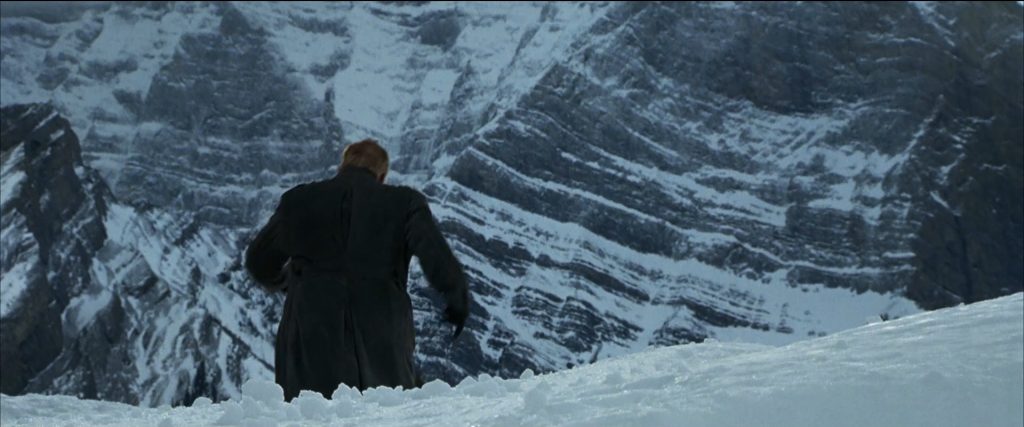
Adding to the continuity of the sequence as it extends across the plot turn is Stryker’s plotline that depicts him rushing to a nearby helicopter, manifesting the escape scenario in the process, before the plot turn [Figure 7]. The film then returns to Stryker, readying the helicopter for takeoff after the plot turn [Figure 8]. By bridging the plot turn with an escape scenario, the plotline offers an additional form of action continuity.


It should be noted that there are occasions that require the splitting of a sequence into two if it crosses a plot turn. Such occasions derive from the methodological aim to establish the ratio of total action duration throughout an act in relation to the duration of that act, which I refer to as AAD ratios that are included in all of the action profiles on this website. From an AAD Ratio perspective, the action sequence splits into two, with the 3rd and 4th act components both running around 19 minutes in duration. From an action continuity perspective, however, the sequence is considerably more epic, with a duration running just over 38 minutes.
4. Action Scenario Continuity: The Aftermath Shot
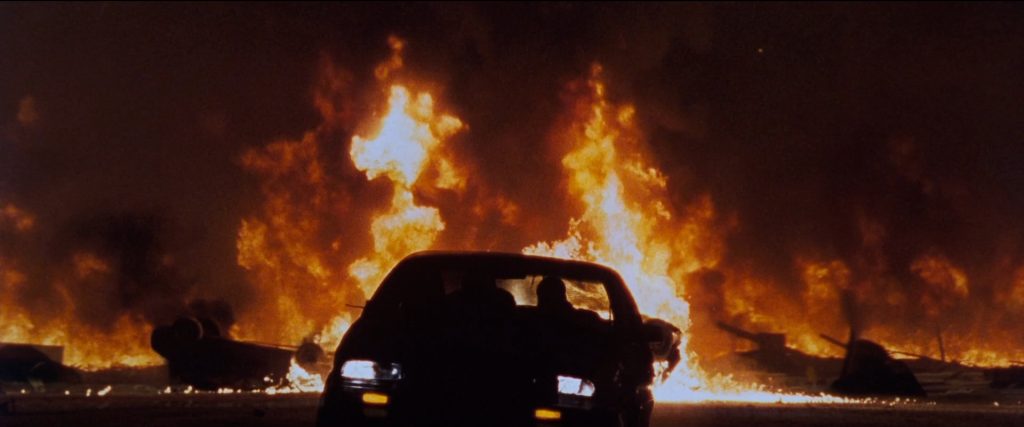
Aftermath shots, in which a shot or set of shots depict the causal consequences of an action scenario event, are forms of punctuation that mark closure to the action event of a particular scene or sequence. While not action in and of themselves, they are reliable markers in most instances of the end of an action scenario event. An example of this occurs in The Long Kiss Goodnight (1996) when Mitch and Charly escape from an exploding chemical bomb on the Niagara Falls International Bridge. Mitch races away from speeding flames that reach the vehicle and shunt it forward, then weaves his way through cars dropping from the sky as a result of the explosion [Figure 9]. An aftermath shot is then presented of the destroyed bridge [Figure 10], bringing the sequence to an end. Despite the shot change, action scenario continuity persists to the aftermath shot as a result of its causal link with the previous shot.

Sometimes, aftermath shots are temporarily deferred by a shot or set of shots, often involving characters looking. In such instances, the action event is extended until the presentation of the aftermath shot. A notable example is provided in Star Wars (1977) during the altercation in the Mos Eisley Cantina. Two criminals, Ponda Baba and Cornelius Evazan, take a dislike to Luke Skywalker and threaten him. Obi-Wan Kenobi comes to his defense and waves his lightsaber, and severs Baba’s arm. The next shot is a blurred image of the impact of the lightsaber on the criminals with the severed arm in descent [Figure 11]. The shot is followed by Luke looking downward, taking in what just happened [Figure 12], with the aftermath shot of the severed arm, presented more legibly than before, and embedded in Luke’s optical point of view [Figure 13]. Like the previous example, the aftermath shot brings continuity and closure to the action-scenario event.


5. Scenic Change: Contiguous Spaces
Does a change in scene on its own constitute an interruption of an action scenario event? To consider the case, one needs to first establish what a scene is. Normally, a scene is understood as a film segment that possesses spatio-temporal unity by occurring in one moment in time and one specific space in a film’s story. The type of scenic change discussed here differs from the cases of ellipsis and parallel editing discussed below. Unlike ellipses, scenic change does not entail a temporal gap between shots, since the shots in question are continuous. Scenic change also differs from parallel editing in that the technique usually entails switching to a different but temporally simultaneous scene. Instances of scenic change that maintain action scenario continuity are ones in which shot change is temporally continuous and spatially contiguous. An example of such scenic change can be found in The Lord of the Rings: The Fellowship of the Ring (2001). Notably, the film’s story centers on a journey across different places, and one strategy the film takes is to demarcate scenic change to viewers by depicting spatial boundaries between the different spaces that the protagonists traverse, and which offer their own distinct set of challenges. After the Fellowship escape from the Mines of Moria, they run across a field, enacting the speed scenario, which is adjacent to the forest of Lothlórien, ruled by Elves [Figure 14]. As they enter the woods, they reduce their pace once they take refuge in the forest [Figure 15], bringing the speed scenario to an end. This transition across spaces is temporally continuous and spatially contiguous, enabling continuity of the speed scenario event but in the context of scenic change.


6. Scenic Change: Sound Bridge
Sound bridges also facilitate action scenario continuity across scenes. A sound bridge is a transitional soundtrack device in which the sound from one scene either begins before the visual cut to that scene or continues into the next scene after the visual cut. In both cases, there is an overlap of sound from a different scene. Despite the scenic change at the visual level, the audio of an action scenario event can extend into either the last shot of a preceding scene or the first shot of a proceeding scene, even if they do not manifest any action. The Fast and the Furious (2001) offers an example of a sound bridge where the sound from the next scene begins before the visual cut. In a scene lacking any action scenario events, Brian and Jesse are working in Dominic Toretto’s automotive shop, where Jesse reveals his attention deficit disorder. In the last shot of the scene, Brian ponders over Jesse’s revelation while on the soundtrack, the spectator hears the approaching roar and the squealing tires of souped-up vehicles [Figure 16]. The film then cuts to the arrival of members of Dominic’s crew, the source of the automotive sounds in the previous shot, who pull into the driveway of Dominic’s house [Figure 17]. The switch from automotive shop to home signals scenic change at the visual level, but the audio over the two shots secures action scenario continuity courtesy of the sound bridge.


7. Temporal Change: Ellipses
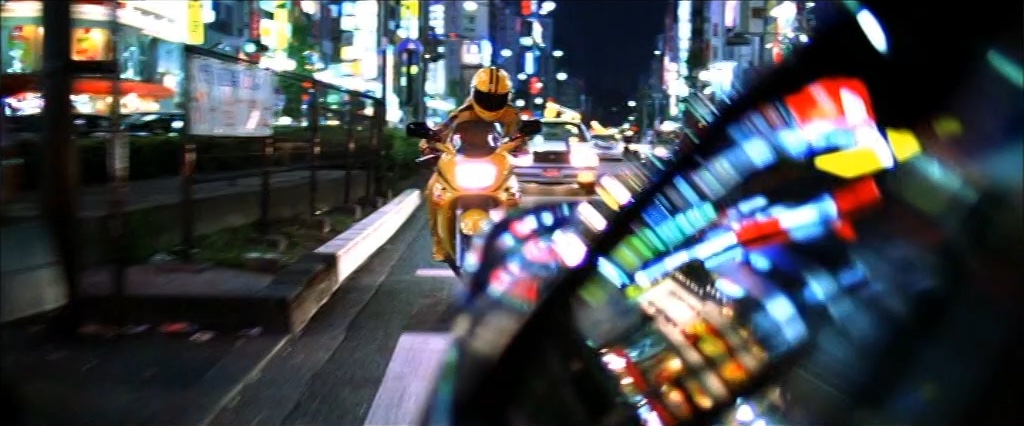
A change in scene often entails a jump ahead in story time and a shift in setting in a film, unlike the case of scenic change discussed above in Principle 5, which presented scenic change but in a manner that was temporally continuous between shots. Such a jump in story time consists of temporal ellipsis, a narrative technique that omits a portion of the sequence of events, effectively skipping over a period of time in a film’s story. Temporal ellipses as a recurrent feature of scenic change can therefore be understood as a potential for interruption of action. In addition, as a narrative technique, temporal ellipses often feature in speed scenarios where entire journeys are rarely shown, to instead to be presented through abbreviated moments. Such an abbreviation of travel entailing speed can be found in Kill Bill: Vol. 1(2003), where The Bride’s arrival in Tokyo is rendered through iconic shots of the city from the plane to her arrival at the airport and then riding a motorcycle through the city. While speeding through Tokyo streets, the Bride is shown riding through a busy intersection [Figure 18] with the next shot presenting the Bride in a different location in the city [Figure 19] with an unspecified amount of time elided from the journey between these moments. Despite the temporal ellipsis, the shots still maintain continuity of the speed scenario event since the spectator infers that The Bride was traveling at the same pace during the elided period of story time.

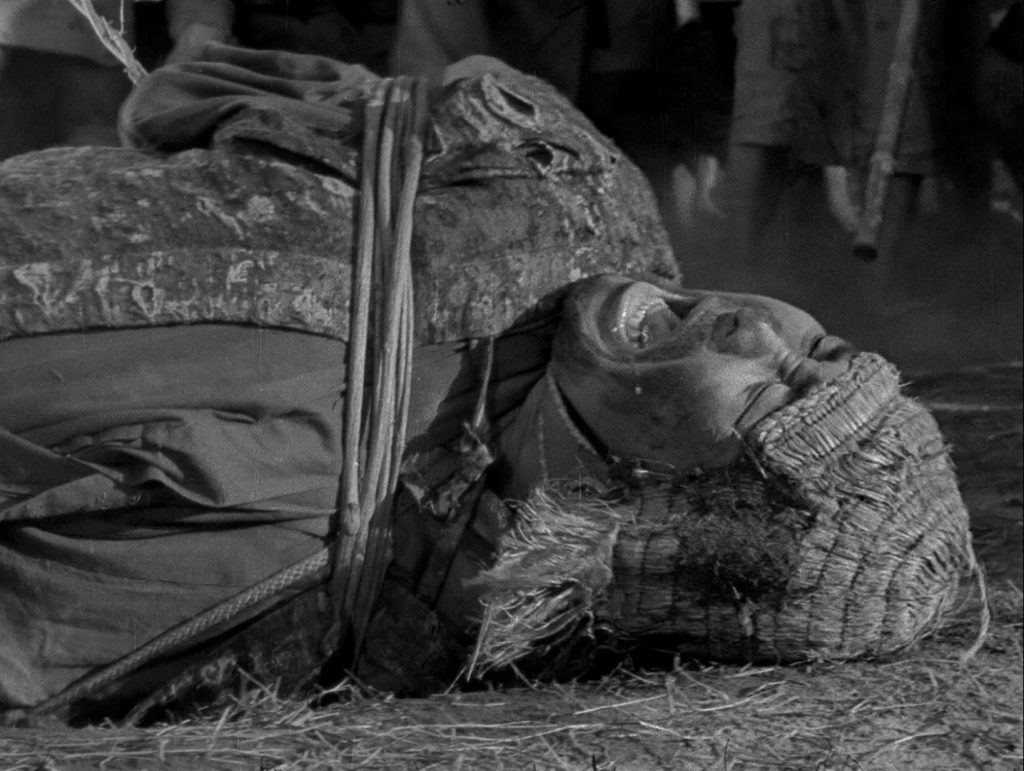
A more complex instance of action scenario continuity presiding over a temporal ellipsis can be found in Seven Samurai (1954). When three scouts from a bandit gang arrive to spy on the village, they are spotted, motivating three samurai to be sent out to the surrounding forest to intercept them. While Kyuzo slices two of the scouts with his sword, Kikuchiyo pounds the third on the ground, with his motives unclear as to whether he seeks to capture the scout or kill him [Figure 20]. A wipe follows this shot, with the narrative skipping ahead to present the scout tightly bound in vines surrounded by angry villagers in the village square, thereby retroactively confirming Kikuchiyo’s intent to capture [Figure 21]. Also inferred is the presumed journey of the samurai who bring the scout back to the village from the forest. Despite the scenic change and temporal ellipsis, continuity of action is preserved as the capture scenario is enacted across the two shots through their causal linkage. Also adding to the continuity of action are Kikuchiyo’s unidirectional kicks to the defenseless bandit and his eventual lynching at the hands of the villagers, rendered off-screen. Such violence enacts the fight scenario, creating a vertical combination with the capture scenario, an action combination more thoroughly examined in Principle 11 below.

8. Temporal Change: Flashbacks and Flashforwards
Temporal change is not restricted to ellipses and can assume different forms. Among these are flashbacks and flashforwards. A flashback occurs when the relations between two consecutive shots represent a jump backward in story time. A flashforward occurs when the relations between two consecutive shots represent a jump forward in story time. When discussing flashbacks and flashforwards, it is important to recognize their subjective nature, meaning they are a depiction of a character’s mental state – memory in the case of flashbacks; visions or intentions in the case of flashforwards. Normally, flashbacks and flashforwards are cued first by a close-up of a character, prompting the viewer to infer their current mental state, which is then followed by a representation of that mental state. From the perspective of continuous action, the question that is of importance is whether flashbacks and flashforwards constitute interruptions in the continuity of action. With respect to the flashback, a notable instance of it occurs in To Live and Die in L.A. (1985) when Richard Chance and John Vukovich, two Secret Service operatives, are pursued by undercover FBI agents. During a suspenseful automotive pursuit sequence, both Richard and John have flashbacks. A close-up shot of Richard’s focused expression is presented [Figure 22], which is followed by his subjective recollection of bungee-jumping off a bridge [Figure 23]. The memory suggests that to Richard, the danger of the pursuit is akin to the adrenaline rush of bungee-jumping. In contrast, John moans in fear during the pursuit [Figure 24], an emotion that incites the traumatic memory of witnessing a killing earlier in the sequence [Figure 25]. These contrasting memories narratively function to differentiate the temperament of the two characters in the context of extreme danger. From the perspective of continuous action, however, these memories pose no interruptions to the pursuit scenario since the chase is ongoing while Richard and John experience these memories.


The same would apply for flashforwards. If an action scenario is ongoing while a character has a vision of a future moment in the film’s story, then it would not constitute an interruption of that action scenario event. The obverse of such action continuity would be the case where there is no ongoing action scenario, with the flashback or the flashforward realizing the action scenario event. An example of a flashforward acting in this capacity can be found in The Limey (1999). Wilson, a British ex-con, travels to Los Angeles to investigate the death of his daughter. His prime suspect is Terry Valentine, a record producer whom his daughter had dated. Wilson sneaks into a party held at Valentine’s house to search for evidence and spots Valentine. Like the close-ups used in the flashbacks in To Live and Die in L.A., the flashforward in The Limey also uses a close-up to prompt speculation as to what is going on in his mind [Figure 26]. What follows next is a representation of Wilson’s intention to shoot Valentine as he walks through the party to approach Valentine and fire at him [Figure 27]. During his walk, the film cuts back twice to shots of Wilson in close-up, underscoring the subjective nature of the depiction, which is imagined rather than an objective flashforward to an actual shooting. It is also a representation of what is to come from Wilson’s standpoint at that moment, as he imagines an event taking place soon. Critically, there is no ongoing action in which the flashforward is situated. Consequently, it is not an interruption of action continuity since the imagined shooting of Valentine instantiates the fight scenario in unidirectional mode.


9. Temporal Change: Story Reordering
Normally, events in a film are presented in chronological order, but can be temporally reordered as the flashbacks and flashforwards illustrated in Principle 8 above. In those examples, the flashbacks and flashforwards were subjective. When those flashbacks and flashforwards are objective and are not filtered through character subjectivity, then they are instances of the temporal reordering of story events in a manner that is not chronological. Temporal reordering, therefore, does not possess the dual time frames of a subjective flashback or a flashforward in which there is the moment when a character remembers the past, or envisions the future, followed by the depiction of past or future events. Since objective temporal reordering entails only one time frame – the time of the depicted event in relation to the film’s overall story – any action continuity must reside at that level. The question to be posed then is whether changes in story order constitute interruptions in action scenario continuity.
The pre-credit sequence of Casino Royale (2006) reveals that changes in story order, which are not consecutive or chronological by their very nature, do indeed constitute interruptions that terminate any action scenario event that has not already come to an end in the previous scene. In the pre-credit sequence, two plotlines are crosscut with each other. The first takes place in Prague, where James Bond confronts Dryden, a corrupt MI6 Section Chief, in his office. The second plotline takes place earlier in the story, involving Bond’s brutal killing of Dryden’s contact. After Dryden challenges Bond by questioning if he has the authority to kill a MI6 Section Chief without the two kills required to attain “00” status, the film cuts to the fight between Bond and the contact taking place in a washroom, a fight scenario in progress [Figure 28]. After crashing through cubicles during their one-on-one fight, the film cuts back to the first plotline when Dryden quickly grabs a pistol from his desk drawer and aims it at Bond, initiating the fight scenario in the first plotline [Figure 29]. Unlike the parallel editing that is understood to cut between two or more temporally simultaneous plotlines, discussed below in Principle 10, the crosscutting in the pre-credit sequence does not exhibit simultaneity as a result of its achronological order. The alternation between the two plotlines also does not entail contiguity or continuity. The cutting between the two plotlines alternates between jumping back in story time to a different scene and then jumping ahead in story time to the present scene. As a result, the pre-credit sequence does not possess action continuity throughout its duration but instead presents an alternation between discrete action moments that reflect the alternation of the crosscutting. Nor is there an underlying action scenario that binds the two plots together.


10. Temporal Change: Parallel Editing
Parallel editing can present an additional action scenario that is temporally concurrent but originates in a different scene. Parallel editing, therefore, assumes temporal concurrence along with a change of scene. Even though parallel editing entails a change of scene, it is assumed that the plot line not currently depicted is still ongoing, running parallel to the plot line that is presently shown. As a result, parallel editing of this kind offers underlying action continuity that can extend across a series of shots and even scenes. An illustrative instance of such parallel editing occurs during the homesteader raid sequence in Straight Shooting (1917). In a last-minute rescue, the film cross-cuts from the cattlemen who attack the Sims’ home by circling and firing at it, and the beleaguered homesteaders inside [Figure 30], to the speeding rescue party that has just departed from their camp [Figure 31]. Despite the scene change, action scenario continuity presides, as it is assumed that the attack on the Sims’ home is ongoing, although temporarily not presented. In addition, as a race-against-time rescue sequence, the two plotlines eventually converge into one, demonstrating their inherent relationship.


In the Straight Shooting example, the shot change from one plot line to another entailed a change in action events. While the cattlemen’s plotline instantiated a vertical combination of the fight scenario with the speed scenario, the rescue party plotline consisted of a vertical combination of the rescue scenario with the speed scenario. What about cases where the change in plot line involves a change in story situation that does not present an action scenario event? Action scenario continuity persists if the action scenario of the first plot line is still ongoing and running parallel to the second plot line that is currently shown. Consider the parallel editing in the extended pursuit sequence in Gone in 60 Seconds (1974). During the pursuit, Maindrian Pace is depicted in an interior shot as he eludes the police while crossing the Gerald Desmond Bridge in a 1973 Ford Mustang Sportsroof that he had stolen [Figure 32]. The next shot presents a reporter interviewing Long Beach citizens about the ongoing chase [Figure 33]. The sequence then returns to the pursuit, this time shown through an exterior shot and later on during the crossing of the bridge [Figure 34], implying that the two plot lines are temporally concurrent with the pursuit preserving action scenario continuity despite the interruption.


11. Action Scenario Change: Vertical Combination
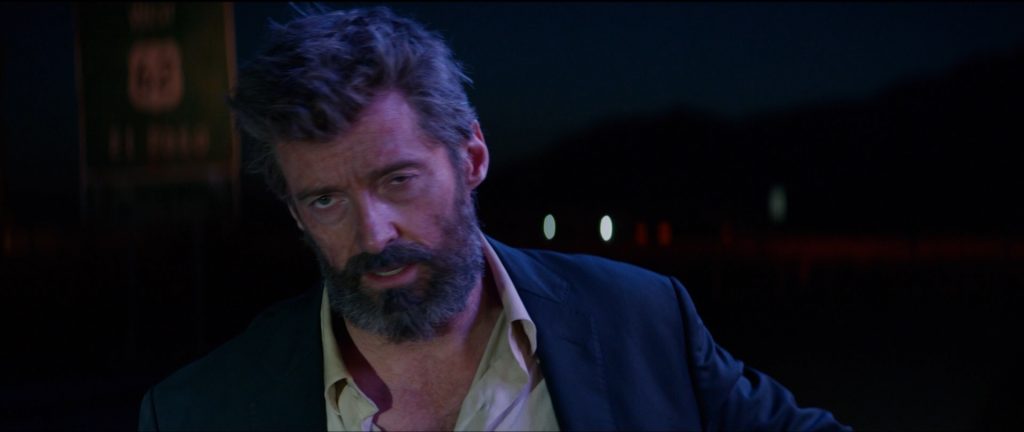
There are other instances beyond parallel editing in which the next shot will depict a different action scenario. In such cases, we are talking about action scenario combinations, an issue that I explored in greater detail in my previous post. If the combination of action is vertical, meaning that the instances of two different action scenarios are concurrent, then the action is continuous since it is implied that the action depicted in the previous shot is ongoing. Vertical combinations, therefore, present the emergence of an additional action scenario, yet originating from the same scene in which the other action scenario is taking place. A good illustration of such a vertical combination can be found in the opening sequence for Logan (2017). Waking up from a drunken stupor inside a limousine, Logan discovers that a group of criminals is busy removing the chrome rim from the front wheel of his vehicle. The film then commences with a heist scenario. Logan then exits the limousine and tries to engage with the thieves [Figure 35] but is promptly shot with a shotgun by one of the criminals [Figure 36]. Through that act of violence, an instance of the fight scenario emerges, but in a manner that is concurrent with the heist scenario, which is ongoing since the thieves are still committed to the theft of the rim.

12. Action Scenario Change: Horizontal Combination
In contrast to vertical combinations are horizontal combinations in which different action forms link up sequentially as a scene or sequence that unfolds over time. If the action scenario combination is horizontal, meaning that the instances of two different action scenarios are consecutive, as opposed to concurrent, as was the case for vertical combinations, then establishing continuous action is less straightforward. Since an action sequence can exhibit both vertical and action combinations, it would be useful to examine a less mixed case of horizontal combination to examine if action continuity presides over changing action scenarios. An illustrative instance of horizontal can be found in Batman (1989). Antoine Rotelli, a rival mobster of the Joker, holds a press conference on the steps of Gotham City Hall. Rotelli is approached by the Joker, who throws a poisonous-tipped feather pen at him, an instance of the fight scenario in unidirectional mode [Figure 37]. The attack widens as the Joker’s henchmen begin shooting at the police with machine guns, who feebly return gunfire with their pistols, with the fight scenario entering into reciprocated mode [Figure 38]. The Joker’s limousine arrives, and the gunfire stops, thus ending the fight scenario, as the Joker makes his way calmly to the vehicle and enters it with his henchmen protecting him. The limousine speeds off with the Joker and his henchmen inside, commencing the escape scenario, coupled with the speed scenario, as Bruce Wayne watches powerlessly [Figure 39]. While temporal and scenic continuity are clearly present in the scene, what provides the connective link between the two action moments is causality. The Joker and his henchmen escape from the scene because they had just committed a crime and want to avoid potential arrest. As far as action scenario combinations go, crime, in fight scenario mode, is often coupled with the desire of perpetrators to escape. It is the goals of the Joker, first to attack and then to escape, that provide the primary causal link between the two action scenarios, securing action continuity in the scene despite action scenario change.


13. Non-Continuous Action Scenario Change
There are cases of action scenario change that lack continuity of action. In these cases, continuity of scene, time, and causal relations are not evident, and there are no underlying action scenarios that link the two moments in question. In such cases, one could imagine a hypothetical action film that consists entirely of a series of consecutive action scenarios set within their distinct scenes but possessing no action continuity across them. Such a film would be a procession of individuated action moments. An example of a non-continuous action scenario change can be found in The Fast and the Furious (2001). At the end of the final heist sequence that goes badly wrong, Vince, a member of Dominic Toretto’s crew, ends up seriously injured. Brian tries to stop the bleeding by making an improvised tourniquet and then radios for an ambulance helicopter. The helicopter arrives, continuing the rescue scenario, and airlifts Vince, presumably to a hospital [Figure 40]. The next shot shows Brian on a freeway rushing to Dominic’s home, enacting the speed scenario [Figure 41]. Notably, the change in shot entails different and non-contiguous scenes of the open countryside and a busy urban freeway. There is also an evident temporal ellipsis between the two shots implied by the assumed time it would take Brian to travel back to the city. There are no direct causal links between the two scenes since Brian’s goals change as well. At the end of the heist scene, he aims to facilitate a rescue; at the start of the next scene, he is intent on confronting Dominic. Most importantly, no underlying action scenario bridges the two scenes, maintaining the two action moments as distinct with no action continuity binding them together.


14. Nondiegetic Title Sequences
So far, we have considered instances of shot change that entailed scenic, temporal, and action scenario change. In all these cases discussion has remained at the diegetic level. When turning to title sequences, one shifts to the nondiegetic realm. Title sequences tend to come in two forms. The first are those in which the text is superimposed over the image. While the letterforms are nondiegetic, the image remains firmly in the story world. In such cases, there is no inherent obstacle to such title sequences that prevents action continuity. The opening title sequence for The Fate of the Furious (2017) can illustrate as the text “Universal Pictures Presents” is layered over an extreme long shot of a Chevrolet Impala traveling down a seawall headed to a street race in Havana, posing no impediment to the progression of the speed scenario [Figure 42].
However, in the second form of title sequences, in which both text and image are nondiegetic, such moments represent a hard stop to action continuity since there is no story world to situate action. The title sequence for Casino Royale (2006) offers a clear illustration. Continuing on the plotlines discussed in Principle 9, after Bond dispatches Dryden for his second kill, the film cuts back to earlier in the story, when Bond picks up his gun from the floor of the washroom. The contact raises himself from the floor quickly and points his weapon toward Bond. The iconic opening-title-gun-barrel-rifling shot of the franchise is then presented, which encircles Bond as he pivots around to shoot the contact before he can fire [Figure 43]. The gun barrel rifling is nondiegetic, but the presence of Bond within the circular frame is diegetic and continues the presentation of the story. However, that diegetic view transitions into a slow dissolve, which in turn dissolves into blood pouring down from the top of the frame. The circular iris is replaced by a diamond-shaped mask that emerges from the center of the frame, revealing design patterns found in a deck of cards [Figure 44]. With the complete shift from a partial diegetic space to a fully nondiegetic title sequence space, the dissolve brings closure to the shot of Bond shooting and an end to the fight scenario. As a wholly nondiegetic space, the title sequence cannot offer any form of continuity – be it scenic, temporal, or action in kind – since they are all diegetic forms of continuity.


15. Action Closure
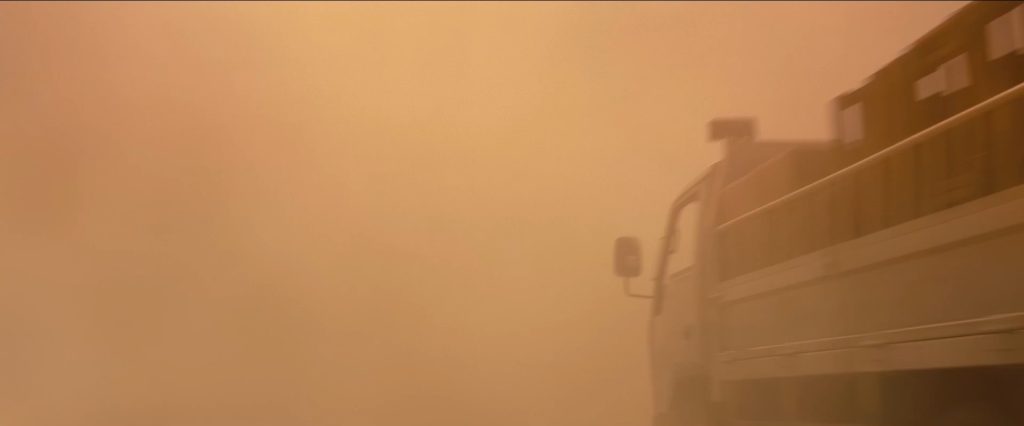
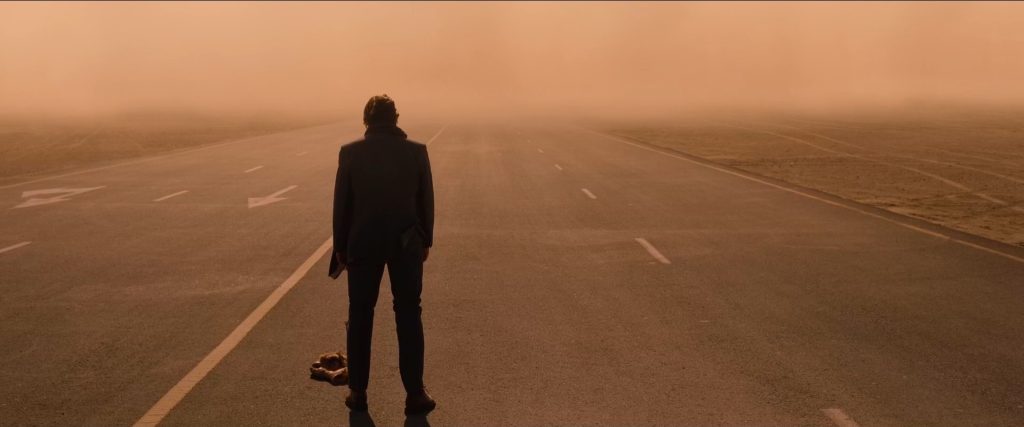
Any set of principles of continuous action that did not refer to how action continuity ends would be incomplete. These principles assume that edits, as shot boundaries, are the devices that bring about the end of an action moment. However, an action moment can also come to an end before an edit. Such cases are forms of in-shot closure, with an example from the film Mission: Impossible – Ghost Protocol (2011) serving as an illustration. The example occurs towards the end of an extended action sequence that segues into a pursuit taking place in a desert sandstorm. Ethan Hunt pursues Wistrom on foot, who has acquired nuclear launch codes. Wistrom latches onto a passing truck and lifts himself onto it. He then turns toward Ethan and takes off his mask, revealing his true identity as Kurt Hendricks, the antagonist of the film. The truck accelerates away from Ethan, disappearing into the sandstorm, with the sound of the truck also fading away, thereby bringing an end to the pursuit and the action sequence in which it is embedded [Figure 45]. Eight seconds then elapse after the action moment has technically ended, presenting Ethan as defeated and isolated in his capture attempt [Figure 46]. The cut following the in-shot action closure offers informational redundancy to the viewer that the action sequence has truly come to an end.
In Principles 2, 3, 5, 6, 7, 8, and 10, it was shown that the main factor sustaining the continuity of action was the presence of underlying action through some form of change in story or narrative presentation. Scenic and temporal continuity, in addition, enable continuity of action by providing the sustaining story conditions, namely, a sufficiently consistent setting, for it to occur. However, when there is no underlying action through a change in story or shift in narrative presentation, then occasions of dialogue, plot turns, scenic change, sound bridges, temporal ellipses, flashbacks, flash-forwards, and parallel editing provide cues that the action moment has come to an end.
Principles 4, 9, 13, and 14, in contrast, present the conditions under which an action moment ends. Aftermath shots, normally, signal the end of an action scene or sequence through the presentation of the causal effects of a previous action moment. Story reordering, through the lack of scenic contiguity and temporal continuity between shots, eliminates the conditions under which continuity of action can be maintained. A non-continuous action scenario change does not exhibit the emergence of an additional action scenario, nor does it possess the causal linkages between two different action scenarios to preserve action continuity. Nondiegetic title sequences terminate action continuity by bringing to an end diegetic time and space and replacing them with the nondiegetic space and time of the title sequences, representing the most absolute stop to the continuity of action.
Action Continuity Decision Chart


Footnotes
- It is important to note at this point that a change in a narrative fiction film is not solely manifested by editing. One-shot films or apparent one-shot films, like 1917 (2019) and Carter (2022), have few visible edits or none at all, but they still manifest significant changes in story and action to sustain viewer interest. Also to be taken into consideration is the fact that changes in story and action often occur within a shot. A shot, for example, may start with an action scenario, such as someone speeding in a car, and then go on to depict the character stopping outside a restaurant and chatting with a friend. Change in action, therefore, occurs within the shot through the termination of the speed scenario to segue into an actionless moment of dialogue. However, since the measurements of the duration of action moments presented on this website are primarily achieved by the use of edits, considerations of in-shot change will be set aside.